We are measuring the mid-market. First thesis: AI is barely a topic.
We continuously observe thousands of mid-sized firms and count what they publish. First thesis from 4,333 job ads: AI is barely a topic.

We are measuring the mid-market. First thesis: AI is barely a topic.
A lot is said about the German-speaking mid-market and very little is counted. We count. We continuously observe companies in Germany and Switzerland and read what they publish themselves: their website and the technology behind it, their job ads, their entries in the commercial register. That is 26 features per company. They are selected by industry, not by topic: mechanical engineering, metalwork, construction, electrical, machining, logistics, tax advisory, elevators, real estate. The result is a broad picture of the state of these companies, measured rather than assumed.
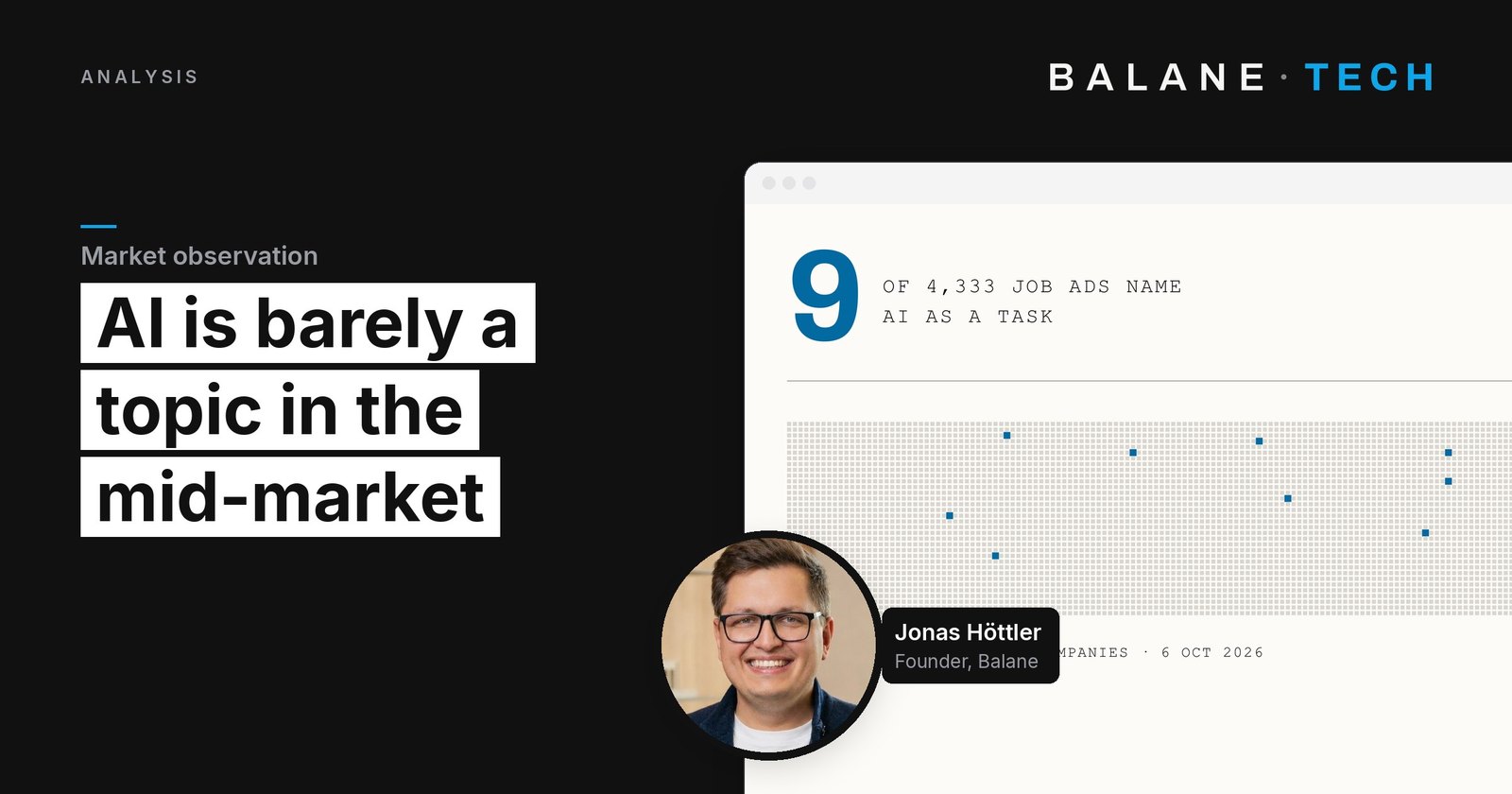
The short answer: today we observe just over 3,000 companies, and the number keeps growing. The first thesis from this data: in the mid-market, AI is barely a topic. In 4,333 job ads it appears as a task nine times.
What we record for each company
| Area | What we record | determined for |
|---|---|---|
| Master data | industry, website, location, legal form | 2,637 to 3,041 companies |
| Technology | mail routing and protection against spoofed senders, domain and hosting, systems in use, certificate log | 1,738 to 2,998 companies |
| Website | availability, legal notice, content management system, customer login, shop, page text | 1,859 to 3,007 companies |
| Jobs | career page, open positions, tasks and requirements | 2,927 checked, 1,280 with ads |
| People and sites | management, locations, team size | 305 to 2,449 companies |
| Business | customer industries, founding year, certifications, headcount | 422 to 1,488 companies |
| Commercial register | founding, capital, management, who may represent the company | open data, 2.19 m companies |
Every company goes through the same steps: confirm the website, read the pages, record the evidence. Only what is evidenced counts. What a company does not publish, such as revenue, stays open. Every analysis is fixed with a date, so numbers change from one text to the next: you can see what moves. No company names, only totals.
First thesis: AI is barely a topic
For the first analysis we read the job ads, because they show what a company hires people for today.
Of the 20 ads that mention AI at all, eleven are coincidence or decoration: AI-generated photos, website footers, a company profile, and twice the German letters "AI" stand for the Swiss canton of Appenzell Innerrhoden. In the vast majority of ads, AI is simply not a topic.
It is not a lack of technical skill. More than one in three production ads asks candidates to set up and program CNC machines or understand PLC controls. AI as a task appears in none of the 322 production ads and in none of the 396 ads for assembly, service and construction.
In the office, three in four ads describe routine: scheduling, invoicing, preparing quotes, answering enquiries. Only about one ad in nine gives the mandate to improve processes, usually as "contributing to". AI as a task appears in two of 497.
How I read this
The ads show what firms are looking for. What follows from that is my reading, not a measurement.
The mid-market is doing too little. The skills needed to rebuild a process rather than just work through it are rarely asked for. Administration carries on. And where firms rationalise, it often means one person is expected to handle more work without additional help. That works for a while, then quality suffers.
AI changes nothing about this as long as nobody has the mandate to touch a process. If you want to change something, the first question is not whom to hire, but which process eats the most time and who is allowed to change it.
How we counted
- Companies: active corporations from the German commercial register whose business purpose matches the industry (no holdings, larger ones first, website confirmed), plus metal trade guilds and OpenStreetMap entries in Upper Bavaria and a business network in Lucerne. Where companies state their size, seven in ten have 50 or more employees.
- Ads: only the companies' own career pages, identical texts counted once, ads behind job portals are missing. Excluded: job lists, a recruitment agency, a university, holding companies and two consultancies listed under the wrong industry in the register.
- AI as a task: every text that mentions AI was read by hand. It only counts where AI is an activity.
- Limits: the selection is not representative, and an ad is not the job. Keyword counts are lower bounds rather than exact values.
The analysis continues
This is not a one-off report. The dataset grows every day, and we keep analysing it from new angles. The analysis continues in three places:
- balane.tech/blog: the analyses themselves, with numbers and method. On LinkedIn: Balane Tech.
- ki-workspace.com: knowledge and context on AI in business, in German. On LinkedIn: KI Workspace.
- hoettler.com: my opinion on what the numbers show. On LinkedIn: Jonas Höttler.

